Quick Answer: Terpinolene is a volatile monoterpene (C10H16) valued in cannabis formulations for its layered piney, floral, herbal, and citrus aroma, which creates complex terpene profiles rather than single-note flavors. It performs well in vapes and concentrates when used at 5–12% total terpene load, but requires careful handling because it degrades above ~230°C and oxidizes quickly with heat, light, or oxygen exposure. Its effects depend heavily on cannabinoid pairing, often energizing with THC and calming with CBD, making it a flexible terpene for effect-targeted product development.
Key Takeaways
- Terpinolene is a monocyclic monoterpene (C10H16) with a boiling point of approximately 186°C, producing a layered piney, floral, herbal, and citrus aroma profile.
- In dominant cannabis profiles, terpinolene typically represents 15–40%+ of total terpene content, shaping bright, energizing strain identities such as sativa-leaning cultivars.
- Research indicates antioxidant, antifungal, sedative, and anti-inflammatory bioactivity, though most supporting evidence comes from in vitro or early-stage in vivo studies.
- Effect behavior shifts by cannabinoid pairing, trending uplifting with THC, calming with CBD, and focus-oriented with CBG, making it useful for segmented SKU development.
- Recommended terpene loads include 5–12% in vape cartridges, 1–2.5% in distillate concentrates, and 0.5–2% in ingestibles, with lower ranges advised for heat-exposed formats.
- Significant degradation occurs above approximately 230°C, with studies identifying 29 reaction byproducts at higher vape temperatures, requiring low-to-moderate heat validation.
- Shop samples from Terpene Belt Farms to evaluate fresh-extracted, COA-verified terpinolene-dominant profiles that preserve aromatic integrity and formulation stability.
Most formulators can name myrcene and limonene in their sleep. Terpinolene keeps getting underestimated. It shows up in trace amounts across a huge range of strains, which makes it easy to treat as background noise.
But in the strains where it’s actually dominant, typically ranging from 15% to well above 40% of the total terpene profile, terpinolene becomes the defining aromatic character of the product and a formulation asset that single-note terpenes simply can’t replicate.
The challenge is that most product teams either ignore it entirely or drop it into a generic citrus or pine blend without accounting for how differently it behaves compared to other monoterpenes. Terpinolene has one of the most nuanced aroma profiles in cannabis and one of the trickiest stability windows. Both of those facts carry real consequences for your product outcome, your hardware compatibility, and your shelf stability.
If you’re building vape SKUs, concentrate formulations, or any product format where terpene performance at heat matters, terpinolene deserves a closer look and a much more precise formulation approach than it usually gets.
What You Need to Know About Terpinolene
Terpinolene is classified as a cyclic monoterpene, but calling it that without context misses what makes it stand out from its terpene family members.
Most of the monoterpenes formulators work with daily, limonene, pinene, and myrcene, which are defined by a single dominant character. Terpinolene doesn’t work that way. Its aromatic behavior is cumulative, and that’s both the opportunity and the complication for product development.
Knowing where terpinolene comes from and how it’s structured helps explain why it performs the way it does in formulation. It’s not an arbitrary chemical quirk. Its behavior follows directly from its molecular architecture.
Chemical Profile and Natural Occurrence
Terpinolene carries the molecular formula C10H16 and a boiling point of approximately 186°C, which places it within a useful vaporization window for most standard vape hardware.
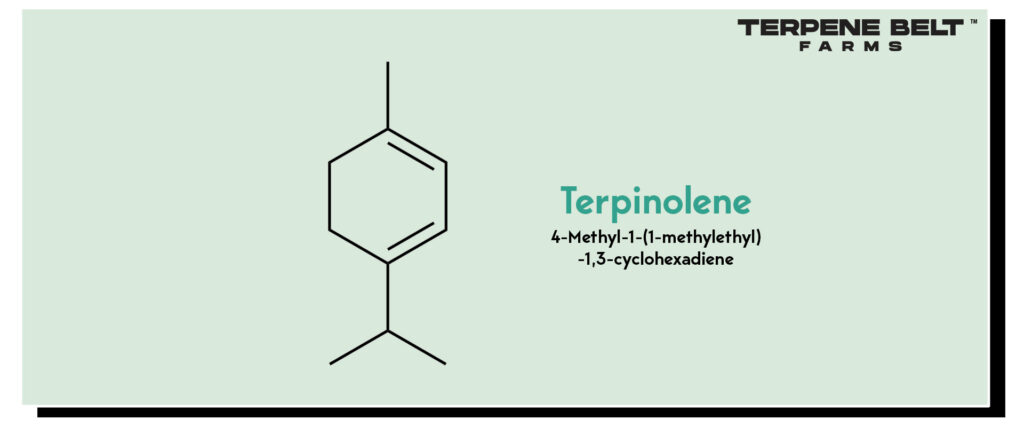
It’s a monocyclic monoterpene, meaning it contains a single six-membered ring structure with a branching side-chain double bond. Those structural features contribute directly to both its aromatic complexity and its volatility.
It appears naturally in a wide range of botanical contexts: cannabis, tea tree, sage, lilac, rosemary, nutmeg, cumin, and apple all contain it in varying concentrations. Unlike single-note terpenes that tend to show up prominently in one class of plant, terpinolene naturally occurs across complex aromatic contexts, which is part of why it reads as layered rather than linear to the nose.
How Terpinolene Differs from Other Monoterpenes
Most monoterpenes give formulators a clear signature: limonene is citrus, pinene is pine, myrcene is earthy and musky. Terpinolene defies that kind of shorthand. Depending on the supporting compounds in the profile, it can register as fresh and citrus-forward, woodsy and herbal, or lightly floral, sometimes all at once within a single profile.
That multidimensional character is what makes terpinolene-dominant profiles a premium, differentiated category. They’re inherently more complex than profiles anchored by a single-note dominant terpene, and they tend to be far rarer.
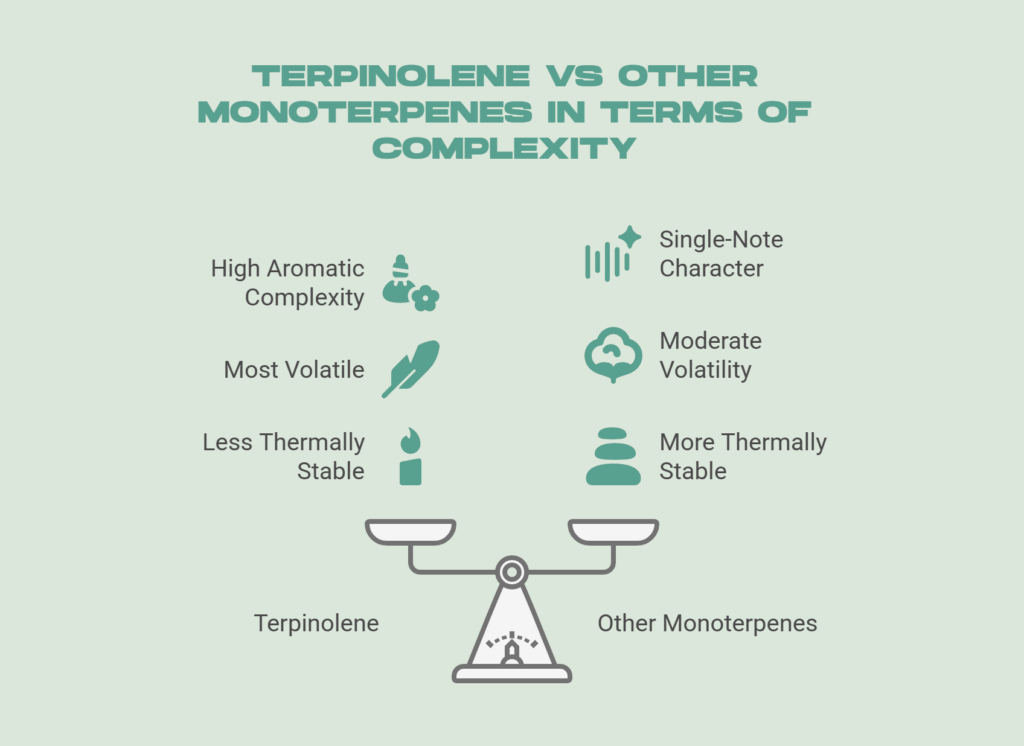
Most cannabis strains carry terpinolene only at low concentrations, which means truly dominant profiles represent a smaller slice of the catalog. Here’s how terpinolene compares to its monoterpene counterparts at a formulation level:
- Terpinolene: Piney, floral, herby, citrusy simultaneously; high aromatic complexity; most volatile of the three; effect behavior shifts with cannabinoid pairing
- Limonene: Bright, single-note citrus character; moderate volatility; broadly uplifting effect association; more thermally stable than terpinolene
- Pinene: Clean pine/forest character; dual isomers (alpha and beta) with slightly different expression; strong bronchodilatory research profile; moderate thermal stability
Terpinolene is also closely related to other terpinene isomers, including alpha-terpinene, beta-terpinene, and gamma-terpinene. Its structural positioning gives it a distinctly different aromatic expression and degradation rate compared to those isomers.
Terpinolene Effects: What the Research Shows
The reported effects of terpinolene span multiple biological areas. They’re relevant both for effect-profile-driven product development and for brands building functional or wellness product lines where terpene bioactivity is part of the value proposition.
Reported Bioactivity
A 2021 systematic review published in Phytomedicine, drawing on 57 studies selected from an initial search of 2,449 articles, found that terpinolene research suggests a broad set of biological effects, with antioxidant, larvicidal, and insecticidal activities showing the strongest evidence base.
The same review documented antifungal, bacteriostatic, antispasmodic, cytoprotective, and anti-inflammatory activity, while noting that most of the supporting evidence comes from in vitro or early-stage in vivo studies rather than clinical trials.
On the antifungal side specifically, a 2020 study published in Letters in Applied Microbiology demonstrated that terpinolene enhanced the antifungal activity of terbinafine against dermatophyte species including Microsporum canis and Trichophyton interdigitale, with synergistic results when the compounds were combined. The proposed mechanism involved disruption of plasma membrane functionality in fungal cells.
A 2013 study from the Journal of Natural Medicine documented a sedative effect when terpinolene was inhaled by mice, identifying that both the double bond in the side-chain and the pi bonds in the six-membered ring play structural roles in that sedative behavior.
Early-stage research has also pointed toward potential anticancer and cardiovascular properties. One study found that terpinolene, combined with alpha-tocopherol and beta-carotene, showed significant inhibition of LDL oxidation. These findings are preliminary and not conclusive, but they’re relevant for brands targeting functional positioning.
Cannabinoid Pairing Behavior
This is where terpinolene separates itself from compounds with fixed effect profiles.
Terpinolene’s behavioral output in a finished product depends heavily on what it’s paired with, which means the same terpene profile can produce meaningfully different consumer experiences depending on the cannabinoid base.
- With THC: Consumer-reported experiences skew energizing, creative, and uplifting, consistent with the classic “sativa” effect that many terpinolene-dominant strains are known for
- With CBD: The combination trends calming and anxiety-reducing, a nearly opposite output compared to THC pairings
- With CBG: Reported association with focus and mental alertness
For product developers building effect-segmented SKUs, a “focus” vape, an “energy” tincture, a “calm” concentrate, terpinolene’s cannabinoid-pairing sensitivity is a feature rather than a complication.
It gives formulators a lever for shifting the experience without changing the aromatic character of the profile. Using terpinolene in isolate form or in botanical blends that strip out minor compounds will produce a flatter, less predictable result than a cannabis-derived profile where the full minor compound context is preserved.
Terpinolene-Dominant Cannabis Strain Profiles
Knowing which strain genetics carry high terpinolene content gives product developers a useful calibration reference for both the flavor and effect targets they’re building toward. This is especially valuable for brands developing strain-named or strain-inspired products, where consumer expectations around aroma and experience are tied to specific cultivar identities.
With that said, the strain name is the shorthand. The terpene profile ratios are the formulation data that actually matters.
Common Strain Characteristics
Terpinolene-dominant strains are predominantly THC-forward and skew sativa or sativa-hybrid in genetic character. This alignment isn’t coincidental. The same cultivation and genetic factors that produce high terpinolene expression tend to produce the uplifting, cerebral effects that sativa-leaning cultivars are associated with.
Strains commonly identified with high terpinolene concentrations include Jack Herer, Dutch Treat, XJ-13, Golden Pineapple, Super Silver Haze, Durban Poison, and Trainwreck. Consumer descriptions across these cultivars are remarkably consistent: fresh, bright, stimulating, and energetic.
This cohesion in reported experience supports the value of terpinolene as a formulation anchor for “daytime” or “creative” effect-category products.
What a Terpinolene-Forward Profile Looks Like
In a terpinolene-dominant profile, the primary compound typically lands between 15% and 40%+ of the total terpene content. When it climbs above 30%, terpinolene becomes the unmistakable lead aromatic. The fresh, bright, slightly piney-floral character is front and center, with supporting compounds layering beneath it.
The supporting terpenes in a terpinolene-dominant profile do significant work in shaping the final character. Here’s how the common supporting compounds shift things:
- High Myrcene Support: Adds earthy body and weight to the profile; can soften terpinolene’s brightness into a more grounded, gas-category expression
- High Ocimene Support: Contributes sweet, tropical, and floral top notes; creates a more fruit-forward, sativa-style profile with less earthiness
- High Limonene Support: Pushes the profile toward bright citrus; amplifies the energetic, uplifting quality and adds zesty sharpness on the front palate
- High Caryophyllene Support: Brings a spicy, peppery depth that adds complexity and balances out terpinolene’s lighter top notes
Knowing these interactions before selecting a profile is how formulators avoid ending up with something that’s technically high in terpinolene but doesn’t deliver the aromatic or effect profile they were targeting.
| Area | Key Finding | Study / Source |
| Antioxidant, Larvicidal, Insecticidal | Strongest evidence base among terpinolene’s biological activities. | 2021 systematic review (Phytomedicine, 57 studies) |
| Antifungal | Enhanced terbinafine antifungal activity against Microsporum canis and Trichophyton interdigitale; synergistic effect. | 2020 study (Letters in Applied Microbiology) |
| Antibacterial / Anti-inflammatory | Evidence of bacteriostatic and anti-inflammatory activity in early research. | 2021 systematic review |
| Antispasmodic / Cytoprotective | Potential to reduce spasms and protect cells under experimental conditions. | 2021 systematic review |
| Sedative Effects | Inhalation produced sedative effects in mice; structural bonds linked to the activity. | 2013 study (Journal of Natural Medicine) |
| Cardiovascular Potential | Combination with alpha-tocopherol and beta-carotene inhibited LDL oxidation in early research. | Preliminary study |
| Cannabinoid Pairing Effects | With THC → energizing; with CBD → calming; with CBG → focus/alertness. | Consumer reports & formulation observations |
Terpinolene Formulation Guide: Dosage, Stability, and Integration
This is where most terpene supplier resources go shallow. Knowing that terpinolene smells complex and appears in Jack Herer is background knowledge.
Knowing exactly how much to add, at what temperature you lose it, and how to prevent premature oxidation in your specific product format is what separates a consistent, market-ready product from a failed batch.
Terpinolene is a monoterpene, which means it’s structurally more reactive and thermally more fragile than the sesquiterpenes most formulators rely on for stability. Treating it like beta-caryophyllene in terms of heat exposure or storage handling is a formulation mistake with real consequences for batch quality.
Dosage by Product Format
Terpene loading ranges are not arbitrary numbers. They’re built around the interaction between volatility, hardware compatibility, carrier viscosity, and consumer experience. Terpinolene-dominant profiles, because of their monoterpene-heavy composition, require particular attention to the lower end of loading ranges for heat-exposed formats.
Cannabis-derived terpinolene profiles also tend to require 20–30% less total concentration than botanical blends to achieve equivalent perceived aromatic intensity, because the preserved minor compounds amplify the lead terpene’s expression rather than leaving it isolated.
- Vape Cartridges: 5–12% total terpene content. Cotton wick hardware stays at 5–8%; ceramic cell hardware can tolerate 8–12%. Terpinolene’s volatility contributes to strong upfront flavor at lower loading rates.
- Concentrates (distillate Enhancement): 1–2.5% terpene addition. High-heat dab formats (700°F+) should stay at the low end of that range to preserve profile integrity.
- Flower Infusion: 0.5–1% by weight. Terpinolene’s volatility makes higher additions counterproductive — excess evaporates before it binds, wasting material. For more details, check out our R&D guide on cannabis flower enhancement.
- Edibles and Tinctures: 0.5–2% depending on matrix. Any heat-exposed edible format (baking, pasteurization) should sit on the lower end and may require encapsulation to prevent full volatilization during processing.
- Pre-Rolls: 0.5–1.5% in combination formats. Infused pre-roll applications benefit from low-temperature infusion methodology.
Thermal Stability
Terpinolene’s boiling point of ~186°C means it fully volatilizes within the standard vape hardware range. That’s actually the good news. The issue begins above 230°C (450°F), where significant degradation occurs and the chemistry of what reaches the consumer starts to change.
Research published in Nature Scientific Reports on monoterpene thermal behavior at vape coil temperatures (100–300°C) identified 29 reaction byproducts specifically from terpinolene under those conditions, with the unchanged portion of the parent compound varying from just 11–28% at higher temperatures.
That’s a dramatic degradation rate compared to more stable terpenes like myrcene, which preserved 97–98% of its parent compound under comparable conditions. This isn’t a reason to avoid terpinolene in vape formats. It’s a reason to formulate within the right temperature parameters and test at your target hardware range before scaling.
Beyond high-heat vaping, terpinolene degrades rapidly during extended baking or pasteurization, making it a poor choice as the primary terpene in any heat-processed edible or beverage application where the matrix is exposed to heat for extended periods.
Monoterpene content, including terpinolene, also drops significantly during cannabis drying and curing, which is precisely why extraction methodology matters so much for profile fidelity. Fresh material extraction, before plant material undergoes drying-related monoterpene loss, preserves terpinolene concentrations that would otherwise be partially or fully lost in standard post-harvest processing.
Integration Best Practices
Terpinolene’s volatility and reactivity with oxygen mean that the handling protocol from the moment the bottle is opened affects final product quality. These aren’t suggestions. They’re the minimum baseline for consistent results.
- Temperature at Addition: Always add terpenes after cooling your base material below 80°F. Adding to warm or hot distillate accelerates the volatilization of the most reactive monoterpene fraction.
- Mixing Method: Stir gently. Aggressive agitation increases surface area exposure and accelerates oxidation of volatile monoterpenes, including terpinolene. This is one of the more commonly overlooked integration errors.
- Storage: Terpinolene-dominant profiles should be stored in sealed, nitrogen-purged containers, away from heat and light. Oxidation and UV exposure both degrade monoterpenes faster than most formulators realize in open-shelf or unpurged storage conditions.
- Vape Testing: Always test your formulation at the target vaporization temperature range (315–350°F for low-temperature, flavor-preserving sessions) before scaling production. Degradation behavior varies by hardware, and validating at scale with a degraded profile is a costly error.
Terpinolene-Dominant TBF Profiles Worth Testing
Sourcing terpinolene-dominant profiles is where most formulators run into their first real limitation. Most suppliers offering terpinolene either carry it as an isolated compound or incorporate it into botanical reconstructions that don’t reflect how terpinolene actually behaves in a full cannabis-derived product.
The profiles below come from single-varietal, cannabis-derived extractions with documented terpene percentages, giving formulators a starting point that’s already calibrated for specific aromatic and effect positioning rather than a blank canvas of generic terpinolene.
2023 Citrus #7 leads with 38.15% terpinolene, backed by 9.80% ocimene and 6.24% limonene. The ocimene keeps the profile sweet and tropical rather than pine-forward, reading closer to white peach and satsuma than a woodsy expression. It’s well-suited for vape cartridges and citrus-forward concentrates, and the high terpinolene content reduces distillate viscosity at lower addition rates, which matters for hardware-sensitive builds.
2023 Pine #122 sits at 40.4% terpinolene with 7.57% myrcene, 6.49% limonene, and 5.48% caryophyllene. Where Citrus #7 reads tropical, Pine #122 leans woodsy and pine-forward, consistent with Trainwreck and Dutch Treat genetics. The myrcene adds earthy body without muting terpinolene’s brightness, making it a strong fit for distillate vape formulations targeting a classic sativa-type aromatic.
2023 Gas #152 pairs 28.13% terpinolene with 20.90% myrcene and 8.66% limonene. The elevated myrcene pulls terpinolene’s brightness into heavier, gas-category territory with a Pink Diesel-type character. Terpinolene’s energizing quality and myrcene’s body create a genuinely balanced result that works well across both vape and concentrate formats.
2023 Pine #120 runs a more moderate 15.69% terpinolene alongside 8.69% myrcene, 8.15% limonene, and 7.18% ocimene. The distributed composition produces a softer, more layered aromatic of ocean spray, cedarwood, and blood orange, making it a practical option for flower infusion or distillate enhancement where a lighter terpinolene expression is the goal.

Why Terpinolene-Rich Profiles Require a Reliable Source
The most common failure point with terpinolene in commercial formulation isn’t the formulation itself. It’s the input material.
Terpinolene-dominant profiles that were handled improperly during extraction, stored in non-purged containers, or derived from dried plant material rather than fresh-harvested cannabis arrive at the formulator with already-degraded monoterpene content. What’s on the COA and what’s in the bottle can be meaningfully different by the time the profile reaches production.
Terpene Belt Farms addresses this at the source. The Fresh Never Frozen extraction methodology captures terpinolene at its highest natural concentration, before the drying and curing process causes the monoterpene loss that standard post-harvest processing introduces.
The difference is measurable, particularly in the minor compound ratios that sit alongside terpinolene in the profile and contribute to both aromatic fidelity and cannabinoid pairing behavior. Every batch comes with full COA documentation and ISO/IEC 17025 testing, so formulators aren’t working from generalized certificate language. They’re working from verified batch data that reflects what’s actually in the product.
If you’re sourcing terpinolene profiles, working from fresh-extracted, batch-verified material is the baseline. Request samples today from Terpene Belt Farms and get verified profile data with every kit.
Frequently Asked Questions About the Terpinolene Terpene
What Does Terpinolene Smell Like?
Terpinolene has a multidimensional aromatic profile that doesn’t reduce to a single descriptor. Most people register it as simultaneously piney, herby, floral, and faintly citrusy. Fresh and complex rather than sharp or linear. The surrounding terpenes in a given profile significantly shape how that character expresses. High ocimene support pushes it sweet and tropical, while high myrcene support grounds it toward earthier, more gas-forward territory.
What Is Terpinolene Used For in Formulation?
Terpinolene is primarily used to add aromatic complexity to vape cartridges, concentrate formulations, and infused flower products. Its layered character, piney, floral, citrusy, and herby, creates profiles that single-note terpenes can’t replicate. It’s particularly effective in citrus-forward, sativa-style, and gas-category vape SKUs, and it can serve as a profile-differentiating compound in distillate formulations where the base is otherwise neutral. It’s not well-suited as the primary terpene in heat-processed edibles due to its thermal volatility.
How Much Terpinolene Should I Add to Distillate?
The typical range for terpene addition to distillate is 1–2.5% total terpene content. For high-heat dab concentrate formats, staying at or below 1.5% is advisable to preserve profile integrity under extreme temperatures. Cannabis-derived terpinolene profiles generally require 20–30% less concentration than botanical equivalents to achieve comparable perceived aromatic intensity, so starting conservative and titrating up through sensory testing is the most reliable approach.
Does Terpinolene Degrade at High Temperatures?
Yes, and more significantly than most other terpenes used in vape formulations. Research on monoterpene thermal behavior at vape coil temperatures found that only 11–28% of the parent terpinolene compound remained unchanged at higher temperature ranges, with 29 reaction byproducts identified between 100–300°C. Significant degradation begins above approximately 230°C (450°F). Terpinolene-dominant profiles are best suited for low-to-moderate temperature vaping (315–350°F) and should be tested at your hardware’s actual operating temperature before scaling.
Sources Used for This Article
- PubChem: “Terpinolene” – pubchem.ncbi.nlm.nih.gov/compound/Terpinolene
- PubMed: “Terpinolene, a Component of Essential Oils from the Plants, Restores Blood-Brain Barrier Disruption and Ameliorates Memory Impairment in Mice with Lipopolysaccharide-Induced Inflammation” – pubmed.ncbi.nlm.nih.gov/34634744/
- PubMed: “Terpinolene, a component of essential oils from the plants, exhibits potent antioxidant and anti-inflammatory activities” – pubmed.ncbi.nlm.nih.gov/32790923/
- PubMed: “Anticancer and antioxidant properties of terpinolene in rat brain cells” – pubmed.ncbi.nlm.nih.gov/23339024/
- Nature: “The monoterpene terpinolene from the oil of Valeriana officinalis modulates the GABAergic system” – nature.com/articles/s41598-022-14236-4