Quick Answer: Humulene is a sesquiterpene (C15H24) found in cannabis and hops that contributes earthy, woody, and spicy depth to terpene profiles while also showing documented anti-inflammatory and antibacterial activity. Because it is heavier and less volatile than monoterpenes, humulene is thermally stable and persists well in vapes, concentrates, and topicals, helping anchor aroma and extend flavor through heating. In formulation, it typically appears at 1–5% of total terpenes, often paired with β-caryophyllene to enhance anti-inflammatory synergy and add structural depth to terpene blends.
Key Takeaways
- Humulene (α-humulene) is a sesquiterpene hydrocarbon (C15H24) and ring-opened isomer of β-caryophyllene, delivering earthy, woody, spicy, and dank aromatic depth.
- Research demonstrates anti-inflammatory activity via NF-κB pathway inhibition, reducing TNF-α, IL-1β, COX-2, and prostaglandin E2, with effects comparable to dexamethasone in animal models.
- Studies show topical, oral, and aerosol anti-inflammatory effects, plus documented antibacterial activity against Staphylococcus aureus and synergistic outcomes with β-caryophyllene.
- In cannabis, humulene typically appears at 1–5% of total terpene content, with 3%+ considered formulation-relevant and 5%+ rare outside OG or gas-dominant profiles.
- Shop R&D samples from Terpene Belt Farms to evaluate COA-verified humulene-present CDT profiles that support authentic aroma, thermal stability, and anti-inflammatory positioning.
What Is Humulene? Chemistry and Sensory Profile
Most formulators encounter humulene as a secondary line on a COA, sitting behind the dominant monoterpenes and caryophyllene before they’ve processed its significance.
That habit costs product quality. Humulene’s chemistry determines how a profile behaves under heat, how it ages on the shelf, and how the aromatic architecture of a finished product reads to the end consumer. Getting familiar with what humulene actually is, at a molecular level, changes how you select and deploy it.
Molecular Structure and Classification
Humulene is classified as a sesquiterpene hydrocarbon, built from three isoprene units for a total of 15 carbon atoms. Its molecular formula is C15H24, and it is formally known as α-humulene to distinguish it from beta variants.
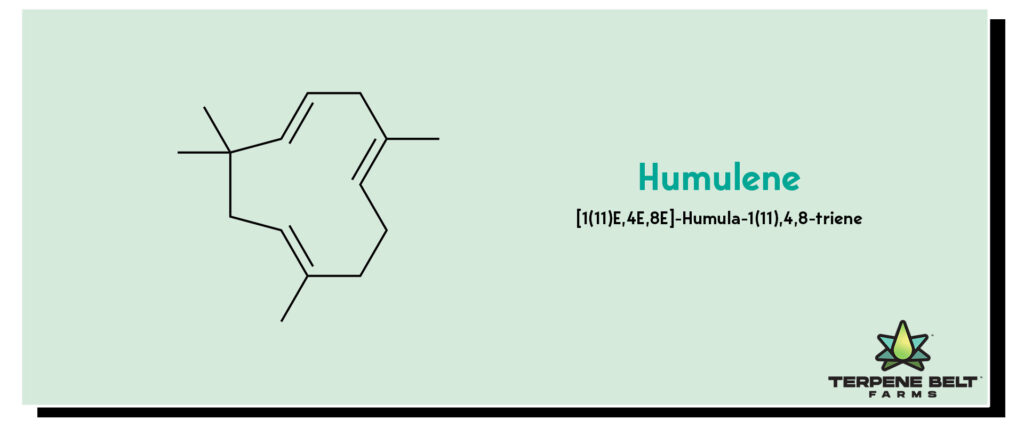
One piece of chemistry that formulators frequently misread is humulene’s relationship to β-caryophyllene. They share the exact same molecular formula, but humulene is a ring-opened isomer.
β-Caryophyllene contains a bicyclic ring structure, while humulene’s open-ring configuration gives it a distinct molecular shape and, critically, different receptor activity. Where β-caryophyllene binds the CB2 receptor and functions similarly to a cannabinoid, humulene does not. Its bioactivity runs through entirely different mechanisms, discussed in the effects section below.
That open-ring structure is also why humulene was historically called α-caryophyllene before receiving its formal classification.
When reading older research, both names refer to the same compound. This distinction matters in formulation because you can’t substitute one for the other and expect equivalent outcomes, whether you’re targeting a specific sensory profile or a wellness claim.
Aroma and Sensory Characteristics
Humulene’s sensory signature sits at the intersection of hops and cannabis. Both of them share that recognizable dank, slightly herbal depth.
Hop essential oils can contain up to 40% humulene by composition, which explains the aromatic overlap. In cannabis, humulene rarely exceeds 5–8% of total terpene content, so it operates as a supporting aromatic note rather than a headline compound.
Its role in profile architecture is to anchor brighter, more volatile monoterpenes that would otherwise read as sharp or one-dimensional on their own.
- Earthy: Deep, soil-like base note that grounds the overall aromatic profile. This is the quality most responsible for cannabis flower reading as “authentic” rather than artificially bright.
- Woody: Dry, structural timber quality reminiscent of aged hops, ginseng root, and clove. Adds perceived depth and complexity behind lighter aromatic compounds.
- Spicy: A mild peppery heat that complements β-caryophyllene’s spice contribution without doubling it. The two terpenes reinforce rather than duplicate each other’s spice direction.
- Herbaceous: Fresh herbal character similar to sage and basil. This is the note most responsible for cannabis profiles reading as botanical rather than purely chemical or sweet.
- Dank: The catch-all term for the heavy, slightly skunky depth that experienced cannabis consumers associate with premium genetics. Humulene is one of the primary sesquiterpene contributors to this quality in authentic CDT profiles.
Humulene Effects and What the Research Says
Humulene gets less attention in formulation content than limonene or myrcene, but its research record is more developed than most people in the cannabis industry realize.
The bioactivity data on humulene goes back decades through work in ethnobotanical and pharmaceutical contexts, and the consistency of findings across different research groups makes this one of the more reliable terpene effect profiles available to formulators making wellness claims.
Anti-Inflammatory Properties
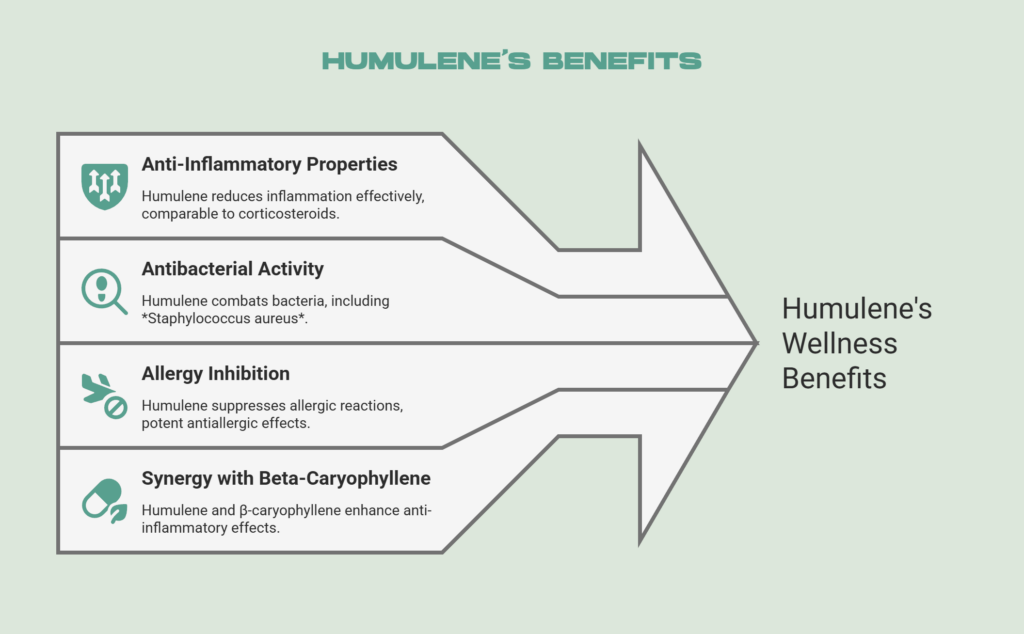
The anti-inflammatory case for humulene is grounded in peer-reviewed science rather than anecdote.
Research published in the European Journal of Pharmacology demonstrated that oral treatment with α-humulene produced marked inhibitory effects across multiple inflammatory models in mice and rats.
The mechanism runs through inhibition of the NF-κB signaling pathway, with reductions documented in TNF-α, IL-1β, prostaglandin E2, inducible nitric oxide synthase (iNOS), and COX-2 expression. The anti-inflammatory potency in those models was comparable to dexamethasone, a corticosteroid used as the benchmark pharmaceutical in the study.
This isn’t limited to oral delivery. A 2009 study published in the British Journal of Pharmacology tested α-humulene in a murine model of airways allergic inflammation and found significant reductions in eosinophil recruitment, inflammatory cytokine levels, and mucus secretion, both orally and via aerosol administration.
For formulators developing inhalable wellness products or topicals targeting inflammatory conditions, that route-of-administration data is directly relevant. Humulene doesn’t just work when swallowed. It demonstrates activity when inhaled and when applied topically, which opens up a broader formulation surface area than most terpenes can claim.
Synergy with Beta-Caryophyllene
The co-occurrence of humulene and β-caryophyllene in cannabis is not coincidental. The two sesquiterpenes are structural isomers, frequently extracted together, and research shows they work better in combination than either compound alone.
Anti-inflammatory work has consistently shown that the caryophyllene-humulene pairing produces additive or complementary outcomes across inflammation pathways. When building a product with a wellness positioning, selecting a profile where both sesquiterpenes appear at 3%+ is more defensible than working with humulene in isolation.
Antibacterial Properties and Other Biological Activity
A 2024 scoping review of α-humulene published in PMC synthesized the existing research and confirmed antibacterial activity, including evidence that humulene-containing essential oil preparations were effective against Staphylococcus aureus, the most common cause of staph infections.
The review also documented dose-dependent inhibition of allergic reactions and anti-anaphylactic effects that were approximately four times the potency of the reference antiallergic drug tranilast in one murine model.
Appetite suppression is frequently cited in consumer-facing content about humulene, and while the mechanism proposed (opposing THC’s appetite-stimulating effects) is plausible, the evidence at this stage is more preliminary than the anti-inflammatory and antibacterial data.
The mild sedative contributions attributed to humulene are secondary, typically enhanced or overridden by the dominant terpenes in a given profile. Formulators should lead their wellness narratives with the anti-inflammatory and antibacterial data, which has the strongest evidentiary foundation.
Humulene in Cannabis: Strain Profiles and Natural Concentrations
Formulators who pull up a COA and skip past humulene because it’s sitting at 3% are misreading the data. Humulene is almost never the dominant terpene in a cannabis strain, but that’s not the benchmark to use when evaluating it.
The right question is whether it’s present at a concentration that contributes meaningfully to sensory complexity and bioactivity.
Which Cannabis Strain Families Carry Humulene
Humulene presence follows a predictable pattern in cannabis genetics. Strains in the OG Kush lineage, GSC (formerly Girl Scout Cookies), Headband, Death Star, OG Kush, White Widow, Sour Diesel, Candyland, and Super Sour Diesel, consistently carry humulene as a co-present sesquiterpene, typically at concentrations that track with their β-caryophyllene levels. The rule of thumb that holds across most COA data is this: high caryophyllene almost always means measurable humulene.
Myrcene-heavy indica-dominant profiles also carry humulene at low-to-moderate concentrations, particularly in strains with a heritage that includes Afghani or Kush genetics. These profiles tend to show humulene in the 1–3% range, which is lower than
OG-lineage strains but still present enough to affect the aromatic tail of the profile. Terpinolene-dominant cultivars and citrus-forward sativa profiles typically carry the least humulene, as their terpene expression tilts heavily toward monoterpenes with limited sesquiterpene support.
Reading Humulene on a COA
When evaluating terpene profiles for formulation, specific thresholds matter:
- Below 1%: Humulene is present but likely negligible for sensory or bioactivity contribution. Not a useful formulation signal.
- 1–3%: Humulene contributes a grounding earthy note and provides minor stabilization support within the sesquiterpene fraction. Relevant for authentic gas or OG profiles.
- 3–5%: Formulation-relevant. Humulene at this range contributes measurably to aromatic depth, shelf stability, and anti-inflammatory profile synergy when paired with caryophyllene.
- Above 5%: Rare for naturally occurring cannabis profiles outside of Gas-forward or OG-dominant cultivars. At this level, humulene becomes an architectural terpene in the profile. The 2023 Gas #10 from TBF carries 8.27% α-humulene alongside 22.63% β-caryophyllene, making it one of the more humulene-forward profiles available in a commercial CDT format.
When sourcing for wellness applications with an anti-inflammatory angle, look at the combined percentage of β-caryophyllene and α-humulene together. If that combined figure sits at 15% or higher of total terpene composition, the profile carries enough sesquiterpene weight to support meaningful effect positioning.
| Humulene Level | % Range | Formulation Relevance | Typical Profile Type |
| Negligible | Below 1% | Aromatic background only | Citrus, sativa-dominant |
| Supporting | 1–3% | Grounding note, minor stability benefit | Indica, myrcene-heavy |
| Actionable | 3–5% | Anti-inflammatory synergy, aromatic depth | OG, gas, caryophyllene-rich |
| Architectural | Above 5% | Full sesquiterpene functionality | Gas #10, premium OG expressions |
| Combined BCP+Humulene | 15%+ combined | Strong wellness positioning potential | Any sesquiterpene-dominant profile |
| Topical threshold | 3%+ in finished blend | Documented anti-inflammatory delivery | Purpose-built wellness topicals |
Formulation Considerations: Where Humulene Shines Across Product Formats
Humulene’s sesquiterpene classification is the single most important thing to keep in mind before deploying it in a formula. Higher molecular weight, lower volatility, and greater thermal resilience all distinguish it from the monoterpenes most formulators are more familiar with. Those properties change what you can ask of it across product types.
Vape Formulations
Research published in PMC comparing terpene evaporation rates found that α-humulene evaporated approximately 190 times slower than α-pinene under equivalent conditions.
That stability advantage means humulene-present profiles hold their mid-note and base aromatic character through the life of a cartridge better than monoterpene-only profiles. For gas-forward or OG-style vapes, it contributes the authentic “dank” depth that reads as premium to experienced consumers.
Target total sesquiterpene content (caryophyllene + humulene combined) at 8–15% of the terpene load to balance stability against viscosity. For more detail, the R&D vape formulation best practices guide covers hardware compatibility and temperature protocols.
Concentrates and Dabbing
Humulene and β-caryophyllene survive typical dabbing temperatures of 230–315°C without significant degradation, while monoterpenes begin breaking down above 200–210°C.
The practical result is flavor staging: lighter monoterpenes volatilize on the initial hit while humulene and caryophyllene persist through the later temperature range, producing a flavor profile that develops rather than front-loads and disappears. Trace additions of 0.2–0.3% α-humulene also improve thermal stability in distillate-based concentrates.
The R&D concentrates formulation guide provides validated starting points across shatter, wax, budder, and live resin formats.
Topicals
Humulene has documented anti-inflammatory activity via topical, oral, and aerosol routes, making it one of the few terpenes with confirmed multi-route bioactivity.
For wellness topicals, target 1–3% within a broader blend and always pair with β-caryophyllene for synergistic effect. Use MCT or hemp seed oil as carrier bases. Humulene will phase-separate in water-dominant formulations without proper emulsification.
Edibles and Gummies
Humulene outperforms most monoterpenes through the 60–85°C filling temperatures typical in gummy production. Keep finished product concentration at 0.05–0.15% by weight. Its earthy character can read as an off-note in bright fruit formats, so it performs better in dark chocolate, coffee, or savory edible matrices.
Dosage Guidelines for Product Developers
Dosage guidance for humulene specifically is thin in most content online, and what exists tends to copy generalized terpene ranges without adjusting for the sesquiterpene distinction. Humulene behaves differently than myrcene or limonene in nearly every format, and the ranges below reflect that reality rather than applying a one-size-fits-all terpene percentage. These figures apply to humulene as a component within a complete terpene profile, not as an isolated compound addition.
By product format:
- Vape Cartridges: 2–7% of total terpene load. Combined sesquiterpene fraction (caryophyllene + humulene) should not exceed 15% of the total oil formulation without hardware compatibility testing.
- Concentrates (Dabs, Live Resin, Sauce): 3–10% within total terpene profile. Higher loads are tolerated due to the consumption method and sesquiterpene thermal stability at dabbing temperatures.
- Topicals: 1–3% within a broader terpene blend. Not intended as a standalone active. Always pair with β-caryophyllene for documented synergy.
- Edibles and Gummies: 0.05–0.15% of finished product weight. Earthiness becomes overpowering in sweet formats above this range.
- Tinctures: 0.3–1% of total formulation weight. Use lipid-based carriers (MCT, fractionated coconut oil) for solubility. Avoid aqueous carrier bases without proper emulsification.
- Infused Flower: 0.5–2% of total terpene blend used in infusion. Higher concentrations in flower applications risk masking the base cultivar’s existing terpene expression.
Signs You’ve Overdosed Humulene in a Formula
Reformulation triggers vary by product type, but there are consistent sensory signals that tell you humulene is running too high relative to the overall profile:
- In Vapes: A pronounced herbal, almost medicinal note at the backend of vapor that reads as off-putting to consumers unfamiliar with authentic cannabis sesquiterpene character. This is more likely when humulene is over 8% of the terpene load without adequate bright monoterpene support.
- In Edibles: A bitter, earthy aftertaste in sweet formats. The matrix amplifies humulene’s aromatic persistence, making overdose more noticeable in gummies and chocolates than in any other format.
- In Topicals: An overpowering dank or herbal scent that conflicts with the product’s consumer positioning, particularly in products marketed to mainstream wellness audiences unfamiliar with cannabis aromatics.
TBF Profiles With Formulation-Relevant Humulene Content
Not every cannabis terpene profile on the market carries humulene at concentrations that matter formulation-wise. Profiles where humulene sits below 1% are aromatic footnotes at best.
That said, humulene doesn’t need to dominate a profile to do its job. Its value in most formulations is additive rather than primary: grounding brighter top notes, stabilizing the sesquiterpene fraction, and contributing to the caryophyllene synergy discussed earlier.
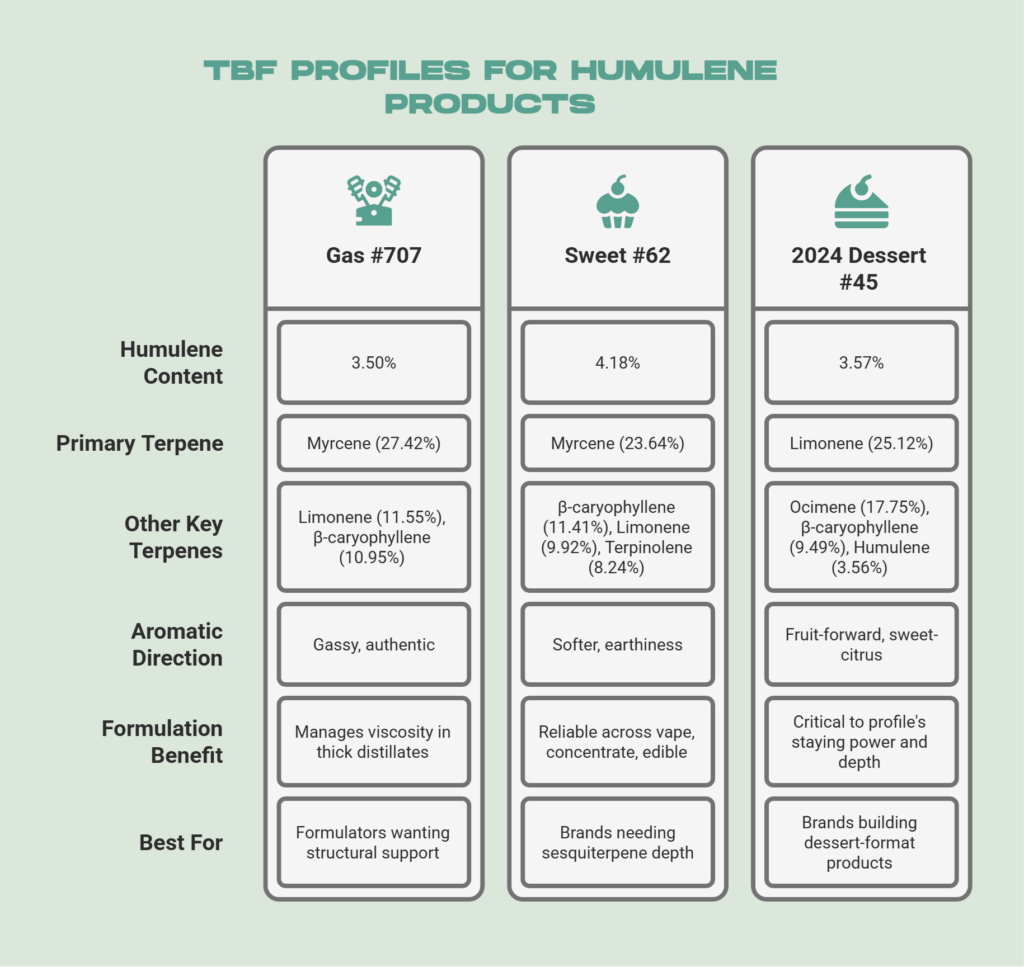
A profile carrying humulene at 3–5% alongside meaningful β-caryophyllene is often more formulation-ready than one where humulene is artificially pushed higher at the expense of balance. The three profiles below reflect that logic across different aromatic directions.
Gas #707 is the most versatile entry point, built for formulators who want humulene’s structural support without committing fully to OG-heavy territory. Myrcene leads at 27.42%, supported by limonene at 11.55%, β-caryophyllene at 10.95%, and α-humulene at 3.50%.
The combined sesquiterpene fraction also helps manage viscosity in thick distillates, giving production teams a functional benefit alongside the aromatic profile. It reads as gassy and authentic without being abrasive.
Moving away from gas-forward applications, Sweet #62 shows what humulene looks like in a softer aromatic frame. Myrcene sits at 23.64%, β-caryophyllene at 11.41%, limonene at 9.92%, terpinolene at 8.24%, and α-humulene at 4.18%.
The monoterpene support from terpinolene and limonene creates enough brightness to soften how the earthiness reads, making this profile well-suited for brands that need sesquiterpene depth without the full gas-forward direction. It performs reliably across vape, concentrate, and edible formats.
For formulators who need humulene in a fruit-forward format rather than a gas or sweet direction, 2024 Dessert #45 offers a useful third angle. Limonene leads at 25.12%, followed by ocimene at 17.75%, β-caryophyllene at 9.49%, α-humulene at 3.57%, and humulene at 3.56%.
The limonene and ocimene combination at the top of the profile creates a bright, sweet-citrus aromatic frame that makes the humulene contribution less perceptible on first impression but critical to the profile’s staying power and depth. It’s a good fit for brands building dessert-format vape or edible products that need authentic sesquiterpene character without the earthy weight that typically comes with it.
Why Terpene Belt Farms Delivers Humulene Profiles Worth Formulating With
Most terpene suppliers can sell you something with humulene on the COA. What they can’t replicate is how humulene ends up in a cannabis-derived profile versus how it appears in a botanical blend or a lab-reconstructed formula.
Terpene Belt Farms extracts directly from Cannabis Sativa L plants cultivated in California’s Central Valley using Fresh Never Frozen methods that preserve the complete terpene fraction at harvest. This matters specifically for sesquiterpenes because humulene and β-caryophyllene are stable enough to survive standard extraction processes, but the minor compounds that surround them in native cannabis expression, the ones that give a profile its full aromatic complexity, are not.
Botanical and synthetic reconstructions consistently produce flat, one-dimensional results at the back of the sensory profile precisely because those trace companions aren’t there.
Each one of our products ships with batch-specific COAs, full terpene breakdowns, and documented third-party testing. For R&D teams that need to justify input selection to internal stakeholders, that documentation makes the supplier evaluation conversation substantially easier. For brands building wellness claims around anti-inflammatory terpene content, COA traceability is not optional.
Request samples for R&D here and see what high-quality humulene-present profiles can do for your lineup today.
Frequently Asked Questions About Humulene Terpene
Is Humulene a Dominant Terpene in Cannabis?
No. Humulene is almost never the primary terpene in a cannabis strain. It typically appears as a secondary or tertiary compound, most commonly in OG Kush lineage, caryophyllene-dominant, and myrcene-heavy indica profiles. Concentrations between 2–8% of total terpene content represent the practical range for cannabis-derived expressions, with anything above 5% considered high for a naturally occurring profile.
What Does Humulene Smell Like?
Humulene’s aroma is earthy, woody, spicy, and herbaceous. It shares the aromatic character that connects cannabis and hops — the dank, slightly peppery depth that signals authentic cannabis genetics. At typical concentrations in a finished product, humulene is a grounding mid-note that anchors brighter top notes like limonene or ocimene rather than a standalone identifiable aroma.
How Does Humulene Differ from Β-Caryophyllene?
They share the same molecular formula (C15H24) but differ in molecular structure. β-Caryophyllene has a bicyclic ring structure and binds the CB2 receptor, functioning somewhat like a cannabinoid. Humulene is a ring-opened isomer with no CB2 activity. Its anti-inflammatory effects operate through NF-κB pathway suppression, COX-2 inhibition, and cytokine modulation. The two co-occur in cannabis and produce synergistic anti-inflammatory outcomes in research settings.
Can Humulene Survive High-Temperature Dabbing?
Yes. As a sesquiterpene, humulene is significantly more thermally stable than monoterpenes. Research and industry formulation data show that caryophyllene and humulene survive typical dabbing temperature ranges of 230–315°C without significant structural degradation, while monoterpenes like myrcene and pinene degrade meaningfully above 200°C. This makes humulene-rich profiles particularly well-suited for concentrate applications where flavor persistence across the full consumption experience is a product goal.
How Do I Know If a Terpene Profile Has Meaningful Humulene?
Pull the COA and look specifically for α-humulene as a labeled compound. Concentrations at or above 3% of total terpene content are formulation-relevant for aromatic and bioactivity purposes. For wellness topical applications, also check the combined β-caryophyllene and α-humulene total. A combined figure of 15% or higher provides the sesquiterpene density needed to support anti-inflammatory product claims. Profiles without explicit humulene identification on the COA may carry it below quantification thresholds, which renders it formulation-neutral.
Sources Used for This Article
- PubChem: “Humulene” – pubchem.ncbi.nlm.nih.gov/compound/Humulene
- PubMed: “Anti-inflammatory effects of compounds alpha-humulene and (-)-trans-caryophyllene isolated from the essential oil of Cordia verbenacea” – pubmed.ncbi.nlm.nih.gov/17559833/
- PubMed Central: “Preventive and therapeutic anti-inflammatory properties of the sesquiterpene α-humulene in experimental airways allergic inflammation” – pmc.ncbi.nlm.nih.gov/articles/PMC2785529/
- PubMed: “Potentiating effect of beta-caryophyllene on anticancer activity of alpha-humulene, isocaryophyllene and paclitaxel” – pubmed.ncbi.nlm.nih.gov/18053325/
- PubMed Central: “Anti-inflammatory effects of α-humulene and β-caryophyllene on pterygium fibroblasts” – pmc.ncbi.nlm.nih.gov/articles/PMC9729099/
- PubMed Central: “The Clinical Translation of α-humulene – A Scoping Review” – pmc.ncbi.nlm.nih.gov/articles/PMC11254484/
- PubMed Central: “Vapor Pressure, Vaping, and Corrections to Misconceptions Related to Medical Cannabis’ Active Pharmaceutical Ingredients’ Physical Properties and Compositions” – pmc.ncbi.nlm.nih.gov/articles/PMC10249740/